


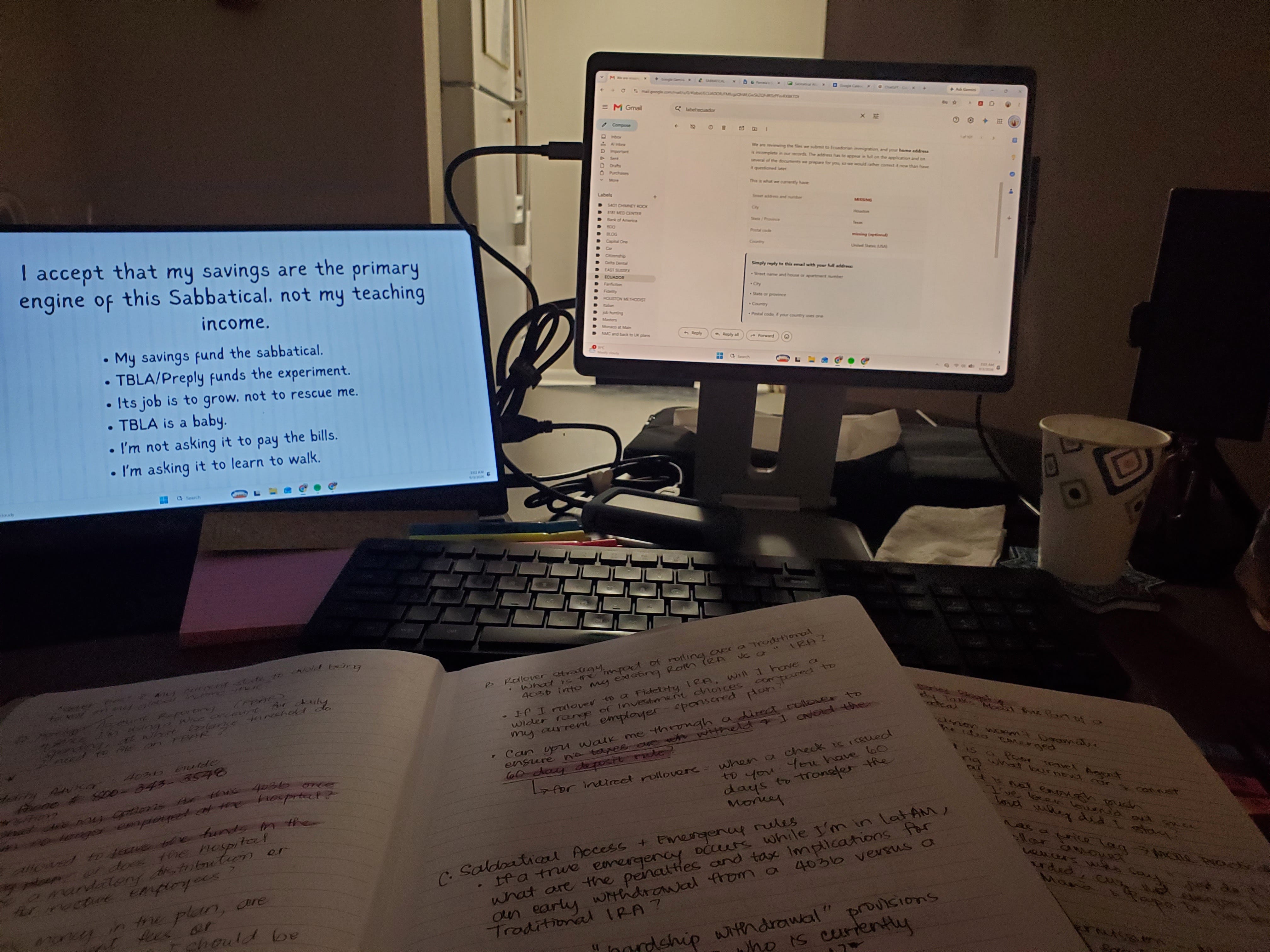
When I first imagined taking a sabbatical, it looked a lot like what my Spanish and Italian teachers were doing. They were traveling, staying in one country after another while using their teaching income to pay for the trip.
Then my idea of a sabbatical started looking like what every other digital nomad online was doing: lazy days, doing a bit of work on their laptops somewhere exotic, chilling by the beach, eating cheap meals, meeting friendly locals, and somehow having all this free time while still earning enough money to sustain the whole thing.
Eventually, I realized how pretentious that fantasy was, how privileged, and more importantly, how much it did not align with who I am or what I actually value.
The Version of Freedom I Actually Want
When I think about freedom now, I think about slow mornings.
I think about sleeping in, writing my blog when I actually feel like writing, going horseback riding and maybe doing multi-day trips along the páramo, teaching my students, building lessons that I know can help international healthcare workers who want to work in Western healthcare systems, and sharing the lessons I picked up along the way as an international nurse.
I think about chilling in a coffee shop, reading a book with my full attention, practicing my arnis, studying Spanish and Italian without feeling mentally fried all the time, and finally getting out of that constant mental math of scheduling life.
Saka na. Pag day off ko na.
That sentence has ruled too much of my life.
I will write later. I will study later. I will exercise later. I will play later. I will do whatever it is that makes me feel like myself later, because right now I have to work.
So yes, there is a fantasy attached to the sabbatical, but it is not really about becoming some digital nomad drinking coconut water in Bali. I do not want to cosplay that lifestyle because that is not what I am after.
What I want is to stop shelving my life around my work schedule.
The problem is, the internet sells the fun part of this lifestyle without really touching the true and real challenges of immigrating or living abroad.
Heck, most of these people do not even call themselves immigrants. They hide behind the term “expat,” as if that somehow exempts them from the realities of navigating conflicting laws, visa requirements, taxes, border rules, cultural differences, learning a language beyond Hola and Buenas noches, paying for expedited documents, figuring out banking, dealing with bureaucracy, and learning how to function inside another country instead of simply consuming it.
And maybe the reason they gloss over these things is that some of them genuinely do not have to deal with them.
If you are American or British, you can enter a lot of countries visa-free for a decent amount of time. So, oo nga naman, anong pake mo sa visa and border rules if you can just show up with your passport and stay for ninety days?
Some of these “expats” also stay illegally under the radar, sell their damn online course, never really integrate, spend most of their time around other expats, and then talk about how they “live like a local” because they know where to buy cheap beer.
Seeing that expat fantasy, I realized that is not what my version of freedom is going to look like.
When the Fantasy Got a Price Tag
The fantasy started falling apart for me when I began consulting lawyers about the visa paths available to me.
That was when it really clicked that this sabbatical was not the same as the trips I had taken before. This was much bigger than I initially thought because now governments were involved, taxes were involved, documentation was involved, and there needed to be a paper trail for almost everything.
Then I got a quote for legal services and realized two things very quickly: this was going to be more expensive than I thought, and I was not going to be able to execute the plan on the original date I had chosen because I simply did not have enough runway yet.
That was when I really started asking myself how much this freedom was actually going to cost me.
My first estimate was about $13,000.
At the time, that number was basically just the projected cost of living for nine months in South America. That was it. I had not accounted for emergencies. I had not thought seriously about a shit-hits-the-fan scenario where I might have to rebuild my life in America after the sabbatical. I also had not properly considered all the costs I would be accumulating while leaving: move-out cleaning fees, furniture haul services, Ubers while tying up loose ends, flight tickets, visa renewal fees, visa application fees, and all the random transition expenses that happen when you dismantle one life before trying to build another.
I was so fixated on the idea of leaving nursing forever that it blinded me to the obvious reality that my teaching business is still a baby. It has not even properly launched at scale yet, and it definitely has not grown enough to fully replace my nursing income.
So I went back to the drawing board.
I used my previous travel and immigration experiences, scoured the internet for information, looked at my current cost of living in the US, converted those numbers against the currencies of the places I planned to stay in, and, probably most importantly, introspected really hard about the kind of person I actually am.
I did not want to budget based on some imaginary version of myself who is perfectly happy living on instant noodles in a ten-bed hostel for a year because “the experience is worth it.”
That is not me.
After re-evaluating everything, I created different baskets and came up with approximately $32,055.
I have five main baskets.
The first is my SHTF Fund, which is basically my return-to-nursing basket.
The second is the Sabbatical Vault, which is the core twelve-month living fund.
Then I have a Catch-All Basket for apartment purging, move-out expenses, transition costs, and all the random crap that happens before I actually get on the plane.
I have a Travel Fund for flights, regional travel, short-stay accommodations, and transportation between destinations.
And then there is the Preply Fund, where my Preply income goes. That one is supposed to support the Sabbatical Vault and cover small daily expenses along the way.
Basically, Preply is Robin to the Sabbatical Vault’s Batman.
The Sabbatical Vault surprised me the most because that was the basket that needed the most revision and the closest look. Once I started calculating what it would actually take to live abroad for nine to twelve months without relying on my nursing paycheck, the sabbatical started feeling very real very quickly.
And that is before you even account for the income I am giving up.
Right now, I make around $5,200 a month as a nurse.
That is money I will no longer be receiving once I leave.
Seeing the full numbers made me anxious and scared, and there have been many times when I thought about delaying the sabbatical again. Maybe I should push it to next year. Maybe the year after that. Maybe I should keep saving until I have more.
Just until I have enough.
But deep down, I have this very strong feeling that if I delay this again, I will never do it.
There is a voice in my head that keeps saying, If you don’t do it this year, it won’t ever happen again, and you will lie on your deathbed wondering and regretting.
And let’s be honest: how much money is enough, anyway?
There will always be rent to pay, internet, water, power, medications to refill. Children to care for. Pets to feed. Debts to pay.
You don’t stop being a parent, medical emergencies will follow you into whatever time zone you are in, and regardless of how much you make, you will still have to pay rent and utilities. So if you wait until everything settles down, you may never get the chance to live the life you truly want.
So despite the uncertainty, despite the fear, and despite the reality that I may not be fully prepared, I am still doing it this year.
Because when will I ever be fully prepared?
There is a point where preparation is responsible, and then there is a point where preparation becomes an excuse to remain afraid.
You Can’t Just “Just Do It”
That is part of why the phrase “just do it” annoys me so much.
It is not completely wrong. That is the irritating part.
There does come a moment when you have to stop planning and actually move.
But “just do it” is so short-sighted, unrealistic, tone-deaf, and incomplete that it becomes almost useless as advice.
It tricks you into thinking that you can JUST do it. As if it’s so easy to quit your job—the thing that actually pays for your food—pack your bags, and book a flight to some exotic island.
Because fuck your dog, fuck your diabetes, and fuck your house, right? They’ll magically deal with themselves?
Because before you “just do it,” you need tactics. You need preparation. You need money. You need enough health and stamina because, really, you think you’re 25? Girl, you’re an old horse like me.
And more importantly, matatawag mo bang kalayaan pag bedridden ka?
The Stuff Nobody Puts in the Reel
You need to think about all the boring shit that never shows up in the Instagram reel.
What happens if you get food poisoning? If you need medication refills?
What happens when there are bank fees, visa extension fees, international call charges, or some government office tells you that you suddenly need another document?
What happens when your laptop breaks?
Do they even have an Apple Store on your cute little island for your MacBook?
What happens when some random vanity item you take for granted at home suddenly costs three times as much because it is imported?
Do they even have longganisa, bagoong, and itlog na maalat?
Whatever stupid little thing you thought would not matter until suddenly it does.
There is also price gouging. Sometimes locals see you as moneybags and artificially inflate rent, transportation, rentals, or services because they know you earn in dollars, pounds, or euros.
And surprisingly, almost no one talks about the cost of language lessons.
I think part of the reason is that many people do not actually intend to integrate.
They think “living with the locals” will magically make them fluent enough to understand bank notices, government announcements, lease agreements, medical instructions, or bureaucratic paperwork.
It will not.
You do not become fluent because you ordered coffee in Spanish three times, por favor.
And language is only one of the things people underestimate—or even ignore completely. Once I started planning this sabbatical seriously, I realized I also had to account for all the ways the plan could go sideways—not because I expect disaster, but because I live by the mantra: “If it can happen, it will happen. And if it can happen to anyone, it can happen to me.”
If I get sick abroad, I plan to buy travel insurance, but the Sabbatical Vault also has enough wiggle room for medical emergencies. If something genuinely catastrophic happens, I fly back to the States and use the SHTF Fund.
If something terminal happens, like cancer or ALS, then honestly, I would probably fly back to the Philippines and prepare for hospice care there.
If I need to come home suddenly for another reason, I unlock the SHTF Fund and start looking for work as an RN again.
If Ecuador becomes more expensive than I expected, I travel to a cheaper country.
If I cannot find nursing work immediately when I return, then that is what the SHTF Fund is for. And if I cannot find work as an RN right away, I am perfectly open to doing something else. Call center. Costco. Walmart. Uber Eats. DoorDash. Whatever pays while I figure out the next step.
I am not above working.
What I am unwilling to do is romanticize being broke.
My personal warning sign is when the Sabbatical Vault hits $3,000.
At that point, I am not going to start calling poverty “minimalism” just so I can protect my ego and continue pretending the sabbatical is working.
I am willing to downgrade. I am willing to let go of comforts. I am willing to skip tours and go on adventures myself. I can cancel Netflix. I can eat out less.
But I am unwilling to pretend that forced austerity is resource management.
If I am staying inside the apartment because I cannot afford a one-dollar coffee, I am not “living cheap.” I am fucking broke, and it is time to return to a day job.
Doing all your laundry in the sink and sleeping long-term in a cramped ten-bed hostel because you literally cannot afford anything else is not some heroic act of adventure.
It is fucking poverty, Pamela.
Go back and put on your scrubs.
The Bridge Back
This is also why I built the SHTF Fund around what happens after the sabbatical.
The sabbatical, to me, is a bridge.
I leave my nurse life and cross into a different life. If that different life becomes sustainable and I want to stay there, then I stay and burn the bridge.
If I realize I want something else, then I cross the bridge back, refuel, and eventually build another bridge toward something new.
The emergency fund is basically the money I need to cross back.
I set aside about $13,000 for that. It covers rent, internet, electricity, phone service, transportation, and job-hunting expenses like Uber fares for in-person interviews.
The reason that amount can stay relatively modest is because I built a Sabbatical Evaluation Framework. By Phase C, if it looks like teaching is not sustainable enough and I need to go back to nursing, I activate the guideline to start applying for nursing jobs while I am still in South America.
That way, my cost of living remains lower while I job hunt.
Ideally, I come back to the States with a job offer already waiting, and all I need to do is find an apartment. That keeps the $13,000 mostly intact.
I had to think about all of this because I do not have Mama and Papa waiting for me if shit hits the fan—again, another detail most influencers leave out.
My parents are broke. I am also no-contact with them.
There is no family home waiting for me if I crash and burn.
Well, I do have a friend who agreed to keep my SHTF luggage and opened her home to me when I return. I also have a best friend half a world away who acts as my sounding board.
And then I have myself.
I am not trying to sound like some pabebe sadboi here, but I really do not have that much of a safety net in the family sense.
What I do have are options I built.
Now that I am an American citizen, I have the privilege of a strong passport.
I also have fourteen years of nursing experience, which means that even though the job market is shit, I still have a clinical background most nurse employers would consider.
My résumé has variety that I can leverage.
I also have experience living in the Philippines, the UK, and the US, so if none of the countries I plan to travel to end up being suitable for me, I can always go back to the Philippines and lie low for a while. I do not have much support there either, but my money will stretch much farther there than it will in the States.
I also have teaching.
It is still in its early stages, but it has the potential to become another strong safety net.
This is where I realized that freedom is not only about cash.
Cash can only go so far because eventually it runs out. A huge part of freedom is knowing that you have options.
If one thing fails, what else can you do?
Can you return to an old career?
Can you work online?
Can you move somewhere cheaper?
Can you go back to another country where you have citizenship or residency rights?
Can you sell an asset?
Can you survive while rebuilding?
Risk Is Not the Same for Everyone
That is why I get irritated when influencers present their structural advantages as if they are purely examples of personal courage.
No one says:
“I am a white, twenty-five-year-old who got bored with my corporate job in London. One day I decided to travel, so I left my apartment and moved all my stuff back into my parents’ house because they have a spare bedroom. I make these videos because they are monetized, and that is what is really funding a big part of my adventure, not the course I am selling because the course is bullcrap. I barely speak the local language because I mostly stay with other expats. I love how cheap everything is because I get paid in GBP and spend in baht. And if all of this fails, I can go home at thirty-five, still young enough to re-enter the workforce, maybe work as a barista for a while, and live with my parents until I get back on my feet.”
No one says it like that.
But they should.
Because those details matter.
Taking a risk is not the same for everyone.
If you jump knowing that there is a giant cushion waiting underneath you, of course the jump is still scary, but let us not pretend that it carries the same consequences as jumping when there is concrete at the bottom.
That is why I wish people would disclose the real dollar values. How much did you actually spend?
Tell me the real difficulty of dealing with foreign bureaucracy.
Tell me how you contribute positively to the country you are staying in.
Tell me your actual source of income.
Is it social media? Papa’s trust fund? A bogus course from influencers teaching influencers how to become influencers? Investments? Remote work? Social Security check? Afam?
What about the meals you skip because the travel lifestyle is not paying enough?
Were you gonna tell us about the instant ramen lunch you had because you cannot afford both a proper lunch and partying tonight?
Are you really “enjoying the beach,” or is it because joining the tour is too expensive?
Tell me that your “minimalist lifestyle” became mandatory because your savings are disappearing and you cannot swallow your pride enough to admit that it may be time to fly home and get a day job again.
That would be honest.
And before anyone assumes I have done all of this without privilege, I have not.
My RN salary made this sabbatical possible.
My savings made it possible.
My material possessions, which I can liquidate into cash, made it possible.
My US passport helps.
My TEFL training helps.
My IELTS tutoring experience helps.
My clinical experience definitely helps.
I also have gold assets I can liquidate if I absolutely need more funds.
My younger self did not have any of that.
What I have now came after fourteen years of career building and, really, decades of sacrifice.
So yes, I am jumping with a cushion underneath me too. But I want to make the distinction that I built this cushion myself.
What My Cushion Is Made Of
The difference is that I know exactly what my cushion is made of. It is fourteen years of nursing experience, an RN salary, savings, immigration, citizenship, credentials, and skills I spent years building.
And there is something almost ridiculous about realizing that the career I am trying to step away from is also the reason I can afford to step away from it in the first place.
Nursing paid for this sabbatical.
Not just in dollars, either.
It paid for it in years. In hair loss, weight gain, anxiety, and alcohol. In relationships—or lack of them. In missed opportunities.
There is a song by Josue called Agos that captures this feeling almost perfectly, especially the part about setting aside what you really want because you still have to go to work.
That is what it has felt like for years.
I keep putting the things that give me energy aside so I can keep doing the thing that drains it.
And after enough years of doing that, you start wondering exactly what you are preserving yourself for.
Another part of the song talks about knowing what you have wanted since you were young, but being afraid of where pursuing it might lead, and getting tired of ignoring it.
That is probably the part that hits me hardest now.
I do not think this sabbatical is a spontaneous act of courage.
I have privilege now, but I am not going to pretend all of it fell into my lap either.
Even the blue passport was not granted to me by the heavens.
I applied for it.
I paid for it.
I stayed long enough to qualify for it.
I paid years of taxes.
The languages I speak were studied, practiced, and refined.
My nursing career took fourteen years to build.
And no, I do not feel guilty for being able to take this sabbatical.
What exactly should I feel guilty about?
I studied hard.
I developed skills outside of what my job required.
I stayed in a demanding career for fourteen years even while my heart, my body, and my soul were struggling.
I kept my head down and did the work.
And now those fourteen years are the footing I can step back onto if I need to return to nursing after the sabbatical.
That does not mean I am invulnerable.
Financially, I am still very vulnerable because I am not a millionaire. The amount I have can sustain this experiment for maybe one to two years before I would eventually need to dip into the SHTF Fund and return to nursing if nothing else becomes sustainable.
I am also vulnerable to the political climates of the places I move through.
A passport helps, but it does not magically remove racism, bureaucracy, profiling, or political instability from the equation.
So no, I would never tell someone to “just do it.”
I would probably just point them toward these Sabbatical Diaries and let them come to their own conclusion, because telling someone to “just do it” does not take their personal circumstances into account.
You cannot always just do it.
Doing it is a process.
Learn the process first, then decide if you still want to do it.
What I’m Actually Paying For
One of the better questions I found myself asking was not “How much money do I need?” but:
What needs to be true for me to quit?
For me, the number was somewhere between $30,000 and $50,000.
I do believe there is such a thing as being financially ready. It is irresponsible to quit your day job with fifty dollars in your wallet and then call the resulting chaos an adventure.
At the same time, expecting the plan to be perfect is unrealistic.
The number will change along a spectrum because there are too many moving parts: conversion rates, political climates, border rules, travel costs, health changes, unexpected expenses.
That is why I stopped thinking in one fixed dollar amount and started thinking in ranges.
And yes, I think freedom is worth delaying long enough to fund it properly. However, there has to be a deadline, because otherwise, it becomes another pipe dream.
There is also a point where planning becomes another excuse not to leave.
For me, that happens when the planning stops producing tangible material outcomes.
If I keep telling myself I am preparing for a sabbatical while ordering stupid shit from Amazon every week, I am not preparing.
If I say I want to leave but then buy a new car, I am probably not serious about leaving.
The plan has to become physical eventually.
The money has to actually appear in the account.
The apartment has to get purged.
The visa has to get filed.
The ticket has to get bought.
That is how I distinguish prudence from fear.
Fear makes me immobile. Prudence pushes me to volition.
For me, that means making the plan concrete enough to move forward without pretending I can eliminate every possible risk. I am willing to take risks, but I am not willing to confuse unnecessary suffering with bravery.
For instance, I am willing to skip wine-tasting tours and explore a park on my own instead. Or cut subscriptions, eat out less, live more simply, and downgrade some comforts.
But I am not trying to prove anything by being miserable.
My definition of “enough” is actually very simple:
I want to cook breakfast, spend the morning teaching or working on my curriculum and lessons, have lunch at a local restaurant, write my blog, cook dinner, and read a book before sleeping.
On weekends, maybe I stroll through the nearby plaza, browse the Sunday markets, or go on a weekend horseback-riding trip.
For me, that is enough.
Don’t get me wrong, this sabbatical was never about not working.
If it were, I would not have bothered earning my TEFL certificate or building my Medical English curriculum.
I am still going to work. I just want to build a different life around it—one where work fits inside my life instead of my life being squeezed into whatever remains after work.
For years, I lived under the saka na, sa day off na system, and I am fucking tired of it. I am tired of shelving life because I have to work—of having an idea I want to write down while I literally have an IV catheter in my hand, or realizing another week has passed without enough mental energy left to properly study Spanish or Italian.
And that is why, to me, freedom has an actual dollar amount.
It is not the fantasy that some social media influencer or random retired expat sells on the Internet, where freedom somehow means coconut water, cheap rent, and chilling by the beach while selling a generic online course. That was never really what I wanted anyway.
My freedom from nursing and from the rat race costs me somewhere between $30,000 and $50,000.
What I am buying with that money is time, travel, and hopefully myself back—the ability to stop postponing the parts of my life that keep getting pushed to saka na, sa day off na.
And for me, that is worth the price.