

I Knew Something Was Wrong Before I Had a Name for It
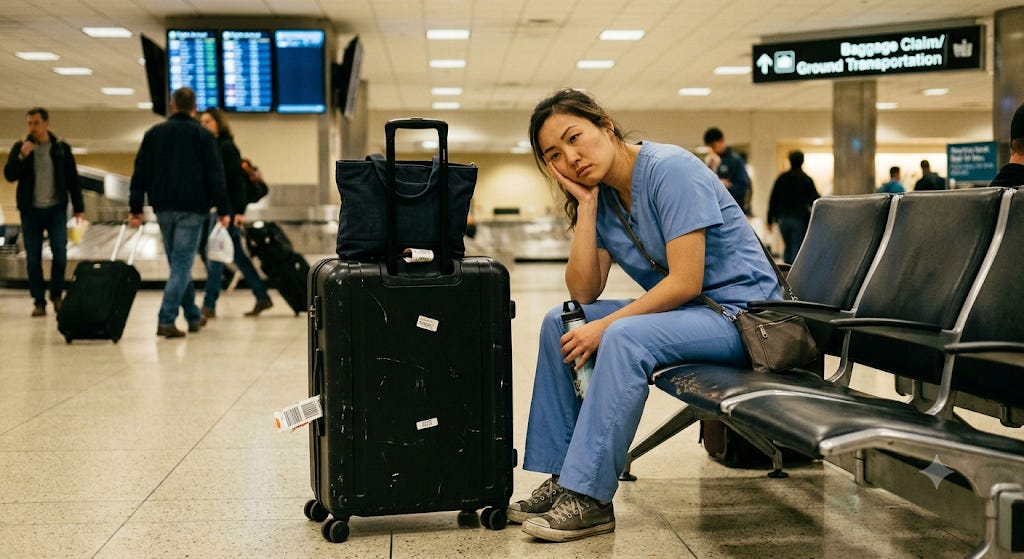
I often say that I have been burned out since 2017.
That was the year I left the Philippines to work as a nurse in the United Kingdom.
At the time, I was excited about living in another country. I was not excited about going back to nursing.
I had already worked as a nurse for about five years in the Philippines, across different settings. After leaving my nursing job in 2015, I spent some time teaching as an IELTS tutor at a review center before my departure for the UK.
I did not yet fully understand how much I hated nursing. Maybe I understood it but had not accepted it.
What I did understand was the contrast.
As an IELTS tutor, I was thanked, appreciated, and welcomed. As a nurse, I could perform chest compressions on a dying man or administer life-saving chemotherapy and still be yelled at because I was not moving fast enough while wrapping individual sheets of carbon paper around highly toxic chemotherapy-infused IV tubing.
A surgeon once called me chimay—a derogatory Tagalog term for house help—in front of my colleagues.
The work could demand precision, endurance, and responsibility from me while offering very little dignity in return.
I knew it was not the life I wanted. But family pressure, poverty, and the naivety of youth made that knowledge feel useless.
Knowing you want to leave is not the same as having somewhere to go.
The Dining Table
I remember one moment from 2017 with unusual clarity.
My mother and I were sitting at the dining table. She asked how much I would earn in the UK. She had a calculator and began converting the salary into Philippine pesos.
Then she decided how much I would need to send home.
I responded automatically:
“Kalahati agad ng sweldo ko sa inyo automatic kasi panganay ako. Ganun talaga.”
Half of my salary would automatically go to them because I was the eldest. That was simply how things were.
As the words left my mouth, I felt a sharp ache in my chest.
The conversation continued, but one question remained in my mind:
Why?
It was as though my mouth was reciting the answer I had been trained to give while my mind was finally beginning to object.
But I was inexperienced and deeply conditioned by an environment that weaponized familial piety. I ignored the discomfort and proceeded with the plan.
Looking back, I think of it like cancer.
In 2017, it was a mole.
By 2019, it had grown.
By 2021, it had spread and begun to bleed.
The warning signs were there: the discomfort whenever obligations were assigned to me without my consent, the immense sadness whenever moving to America was discussed, and the pounding in my chest whenever conversations among Filipinos turned toward nursing, sending money home, and sacrificing for family.
So if the signs were there, why did I let it fester for too long?
Well, I kept treating those reactions as personal weakness instead of information.
Why Burnout Was Not Enough
People speak about burnout as though recognizing it naturally leads to change.
It does not.
Burnout is easy to rationalize as tiredness, stress, or the ordinary cost of adulthood.
And when the thing burning you out is also paying your rent, funding your immigration, supporting your family, and keeping you financially secure, you begin to ask whether you even have the right to resent it.
Do you bite the hand that feeds you?
Money was the strongest force keeping me in nursing. I obviously needed to pay my bills, and for years, I also had family obligations.
Then came sunk cost. I had spent fourteen years becoming competent. Don’t get me wrong, I was not the sharpest tool in the box, but I was sharp enough to be relied upon, to lead, and to function with minimal supervision.
Responsibility came next.
Then the lack of alternatives.
Then immigration.
People from the Global North can romanticize reinvention because many of them have fallback options. They can move into Papa’s garage. They can return home if the experiment fails. They are not faced with deportation and legal fees when they feel “lost” in their “spiritual journey”. They can decide to Eat, Pray, Love without first navigating visa applications, legal fees, proof of funds, immigration restrictions, and the requirement to secure somewhere to sleep before even entering the country.
I did not have those safety nets. I was Plan B. I am the fallback.
Fear and identity also kept me in place. Nursing was what I studied. It was the skill I had spent years developing. I did not know what else I could do that anyone would pay me for.
Burnout kept telling me that I needed to leave.
But Reality kept asking me “how?”
Every Cure Failed
Over the years, I tried almost every commonly prescribed cure for burnout.
Vacations.
Therapy.
Remote nursing.
Non-bedside roles.
Luxury purchases.
Exercise.
Hobbies.
Language classes.
None of them solved the problem.
Some made me feel better temporarily, but they were Band-Aids over a bleeding jugular.
Vacations made me happy because I was outside the job. Of course I felt better. I was not wiping asses, responding to alarms, or being held responsible for someone else’s body.
Then the trip ended, and I returned to the same life.
Therapy gave me a safe place to say the ugly things out loud. I could vent, admit intrusive thoughts, and speak honestly to a professional without being judged.
But when the session ended and I returned to work, the relief disappeared.
A non-bedside position removed some of the physical degradation, but I eventually realized it operated under the same extraction principle: the patient is king, and the worker must continue giving.
Luxury purchases gave me a dopamine rush until I had to work overtime to pay for them.
Exercise worked until it became another obligation I had to force into a night-shift schedule. The activity intended to restore me became another logistical problem involving sleep, timing, and recovery.
Hobbies sounded good in theory, but after working three consecutive night shifts, creating something felt like another task.
Language learning gave me temporary stimulation, but I rarely had enough bandwidth to practice outside class. My progress stayed slow because the job consumed the energy required for growth.
But the failure of these remedies still did not tell me what should replace nursing. They proved that I needed to leave; they did not make leaving possible.
Advice for Tired People
Burned-out workers are often given the same advice:
-Stop expecting work to fulfill every part of your life.
-A job is just a job.
-Find meaning outside work.
-Set boundaries.
-Practice gratitude.
-Take a walk.
-Drink some water.
-Just say no.
-Stop caring so much.
-Do the bare minimum.
-Leave work at work.
I hate all of it because they’re coping responses. They’re not solutions. They’re the steady pressure you apply onto a bleeding laceration until you can get to an emergency room.
That advice may help tired people, but it does not help empty healthcare workers.
What does “do the bare minimum” even mean when a patient is in cardiac arrest? Do I do 30 chest compressions and then I get to clock out? After all, I’ve already done my part, right?
What boundary am I supposed to enforce when someone’s mother has soiled herself and needs to be cleaned? Should I announce that I am going on break? Would the family be understanding because I am practicing self-care?
Of course not.
Healthcare does not consistently allow workers to disengage without transferring the cost of that disengagement onto another human being. I can already hear “they need to hire more nurses/staff”, or "the staffing ration needs to change”— as if that negates the true parasitic nature of the profession. As if hiring more bodies changes the extractive dynamic.
That is what much of the advice fails to acknowledge.
The problem was that the work required more— whether I had any left to give or not— and gave nothing back.
Coping advice may help a person survive long enough to make a plan, but it cannot become the plan itself.
I Was Solving the Wrong Problem
For years, I thought I needed an easier nursing job.
Less physical labor.
Fewer hours.
More paid time off.
A better schedule.
A remote role.
But nursing already offered some of those things.
Bedside nurses often work three twelve-hour shifts rather than a traditional forty-hour week. Non-bedside roles exist. Some hospitals offer better leave packages. Remote jobs remove many of the most physically exhausting parts of patient care.
I eventually obtained the kind of nursing job many people would consider ideal: stable, remote, and well-paid.
I was still miserable.
That forced me to confront the actual problem.
The goal was not an easier job.
The goal was autonomy. Freedom.
And as long as I remained in nursing, I did not feel free.
My schedule still belonged to someone else. My travel required approval. My energy was still being consumed by work I did not believe in. Even from home, I remained tethered to the same profession and the same structure.
I had spent years trying to redesign the cage, but had not yet accepted that I wanted to leave it.
An Alarm Is Not a Map
Burnout can tell you that something is wrong.
It can tell you that your body is depleted, your patience is gone, your curiosity is fading, and the life you have built is no longer sustainable.
It can tell you to leave.
But burnout is a poor travel agent. It can point away from the life hurting you, but it cannot tell you where to go, how much the journey will cost, or what you will live on when you arrive.
For years, burnout pointed me away from nursing while offering no destination beyond it. It could not identify which of my other skills might earn money. It could not build my savings, test an alternative career, calculate the risks, or create a timeline.
That is why I stayed as long as I did.
Pain created urgency, but urgency was not a plan. I still had to decide what I wanted my life to look like, find work I could tolerate, and build an exit sturdy enough to survive reality.
Burnout taught me that I could not stay.
Planning taught me how to leave.